What a box of RAM, a disappointed twelve-year-old, and one crowded doodle made me wonder about 2026
Most Saturdays, you will find me in one of the quieter corners of my home.
Not because I have discovered some elevated form of weekend discipline. By Saturday, my body has usually had enough of the week and has begun issuing formal notices. I have learned, somewhat reluctantly, to listen.
These pauses have become non-negotiable.
I step away from the screens, the messages, the meetings, and the strange modern habit of checking one device because another device made a sound. I return to things that move at a slower pace: a notebook, a cup of coffee, and a few pens.
Micron Pigmas, mostly.
I own enough of them to suggest either a serious creative practice or a small stationery-related crisis. I prefer the first explanation.
There is something calming about drawing with ink. Digital work is endlessly reversible. You can undo, duplicate, regenerate, revise, and continue polishing until the original idea has quietly left the room. Ink offers no such comfort. Once a line is on the page, it stays there.
You learn to work with it.
Perhaps that is why I return to it. A week spent making decisions, reviewing work, negotiating ambiguity, and moving between conversations can leave the mind full but oddly shapeless. Drawing helps give that noise somewhere to go.
This Saturday had begun in much the same way.
The room was quiet. The notebook was open. The coffee was still warm.
Then my twelve-year-old arrived with a proposal.
“I think we should build a gaming PC.”
The word we was doing a great deal of work in that sentence.
“What do you need it for?” I asked.
“Gaming.”
There was no elaborate speech about schoolwork, coding, artificial intelligence, future careers, or how this computer would prepare her for the changing world of work. She wanted to play games. She also wanted one of those glass-sided computer cases filled with glowing RGB lights.
Mostly the lights, I suspect.
Still, the idea sounded fun, so we opened a few websites and began building the machine.
Processor. Graphics card. Storage. Cooling. Power supply. A case that appeared capable of directing air traffic.
Then we reached the RAM.
I looked at the price.
I refreshed the page.
The price remained where it was, which felt unnecessarily stubborn.
It was close to three times what I remembered seeing six months earlier.
“Did we choose too much?” she asked.
“No.”
“Did you accidentally add two?”
“No.”
“Can we remove it?”
“Not if you would like the computer to work.”
That was the moment our father-daughter technology project became a lesson in economics.
We abandoned the gaming PC. She began pouting. I began calculating whether an ice cream cake would be cheaper than a memory upgrade and more effective at restoring peace.
The cake won.
But the price of the RAM stayed with me.
The physical world sends an invoice
We talk about models, agents, assistants, generated content, reasoning, workflows, and interfaces. We say things happen “in the cloud,” which is a lovely phrase because clouds appear light, soft, and free.
They are none of those things.
Behind every effortless response is a very physical chain of machines, chips, memory, power, cooling systems, networks, buildings, labour, and money.
The software may feel magical. The infrastructure receives an electricity bill.
That small box of RAM reminded me of something we often forget during periods of technological excitement: digital abundance still depends on physical scarcity.
We can generate endless words, images, summaries, videos, prototypes, plans, and recommendations. Yet the systems doing that work require real hardware. That hardware has limits. So does the energy that runs it, the money that pays for it, and the human attention needed to make sense of everything it produces.
The infinity symbol looks elegant in a presentation.
It becomes less elegant when somebody has to fund it.
Perhaps that is why the price bothered me more than it should have. It was not only about a computer we had decided not to buy. It felt like the physical world tapping us on the shoulder and saying, “All this intelligence you have been celebrating has weight.”
A few hours later, I went back to my notebook.
I had no article in mind. No framework. No plan to explain the year.
I simply started drawing.
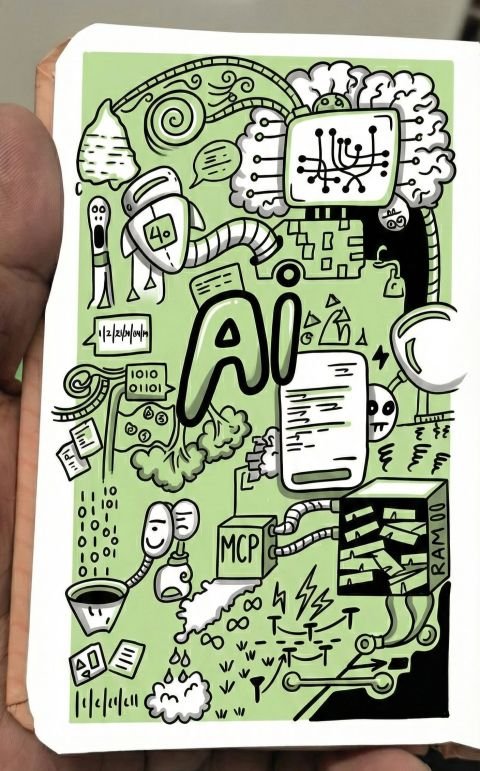
The page slowly filled with fragments. Technology, noise, faces, machines, signals, symbols, and whatever else had been sitting in my head after a year that seemed to move faster than anyone could properly absorb.
When I finally stopped, almost no empty space remained.
The page looked like the year had felt: crowded, energetic, expensive, confusing, inventive, and slightly out of breath.
I had not planned it that way.
Perhaps that was the point.
A year of absolute capability
2025 has been an extraordinary year for artificial intelligence.
That word, extraordinary, is used too easily, but here it is justified.
The systems became more conversational, more accessible, more capable, and far easier to place in the hands of ordinary people. Work that once required specialist knowledge could now begin with a sentence typed into a box.
You could show the system an image. Speak to it. Ask a vague question. Change your mind halfway through. Give it a file. Ask it to explain, rewrite, compare, code, summarise, plan, or generate.
The barrier between intent and output became much thinner.
That change matters.
AI stopped feeling like something happening elsewhere and became something people could invite into their daily work. Designers used it to explore ideas. Engineers used it to understand code. Leaders used it to work through dense reports. Students used it to ask questions they may have been too embarrassed to ask in class.
Some of it was genuinely useful.
Some of it was remarkable.
Some of it was a chatbot attached to a product that had never needed a chatbot.
Almost every roadmap acquired an AI lane. Every strategy discussion eventually reached the question, “Where does AI fit?” Every presentation seemed to develop at least one small sparkle icon.
In a few cases, the sparkle icon appeared to be doing most of the strategic work.
The pace was thrilling. It was also difficult to process.
Every week brought another model, another benchmark, another tool, another demonstration, another claim that a familiar profession was about to be transformed beyond recognition.
Yesterday’s breakthrough became today’s baseline and tomorrow’s outdated screenshot.
We spent much of the year asking one question:
What can the model do?
It was the right question for the moment.
Can it write this?
Can it build that?
Can it read a thousand documents?
Can it create an interface?
Can it plan a project?
Can it take action?
Can it coordinate with other systems?
Can it complete the work while I sleep?
Each successful demonstration pushed the next question further. We moved from text to images, from images to video, from answers to actions, and from assistants that responded to agents that promised to operate on our behalf.
Capability rose quickly.
Our ability to place that capability well did not always move at the same speed.
Powerful technology searching for somewhere to stand
This created a strange situation across many products and organisations.
We had powerful technology searching for a suitable place to stand.
Teams began with the capability and worked backwards toward a user need. If the model could summarise, products needed a summary. If it could generate recommendations, users suddenly needed recommendations. If it could support a conversational interface, a chat window appeared somewhere in the experience.
Sometimes this created real value.
Sometimes it created a feature that demonstrated the model more clearly than it helped the person using it.
I have been in versions of this conversation more than once.
“We can generate thirty recommendations.”
“How many does the user need?”
“Probably one.”
“What are they supposed to do with the other twenty-nine?”
At this point, the room usually becomes deeply interested in the ceiling.
Generation is impressive. Selection remains work.
In some cases, AI reduced effort. In others, it moved the effort from creating something to reviewing what had been created.
A person who once wrote one paragraph now checks five generated paragraphs.
A manager who once made a decision now reviews twelve suggested decisions.
A learner looking for a clear answer receives a beautifully written page when two sentences would have done.
The output increases.
The outcome may not.
That distinction became one of the more important lessons of the year.
When production becomes cheap, judgment becomes expensive.
The more a system creates, the more somebody must decide what is useful, what is accurate, what is safe, what sounds plausible, and what should be quietly deleted before it reaches a customer.
The burden does not disappear. It changes shape.
And because the output arrives quickly, that burden can be easy to miss.
A generated document feels like time saved until someone spends forty minutes checking every claim. A set of generated design directions feels productive until the team spends the next meeting deciding which ones solve the actual problem. A summary feels efficient until an important detail is lost and somebody has to return to the original source.
Speed at the point of generation can hide work further down the line.
This does not make the technology less valuable.
It means value cannot be measured by output alone.
The burden of infinite possibility
For years, many systems were constrained by how much they could produce.
AI changes that.
We can now produce more words, more screens, more concepts, more code, more recommendations, and more variations than most people could reasonably consume.
The constraint is moving.
We are no longer limited only by the ability to create. We are increasingly limited by our ability to choose.
This appears in small, ordinary moments.
A person asks for help writing an email and receives six versions in six different tones. A designer asks for concepts and receives a wall of possible interfaces. A leader asks for a summary and gets something longer than the document being summarised.
The machine has completed its task.
The human has acquired a new one.
More choice can feel like freedom. Beyond a certain point, it becomes administration.
This is one of the risks of treating output as the main sign of intelligence. A system can give us more and still leave us with more to do.
The truly useful system may be the one that understands when not to generate.
It may recognise that the person does not need ten options. They need one reasonable starting point.
It may notice that the user already has enough information and help them make a decision.
It may understand that another notification will add anxiety rather than value.
It may complete a small, predictable action without turning the moment into a demonstration of technological progress.
This kind of restraint is less exciting on stage.
It produces fewer dramatic launch videos.
It is also what makes technology livable.
Almost right is a difficult place to be
The other challenge of the year has been trust.
AI systems can be astonishingly useful while still being confidently wrong.
The failure is not always dramatic. Often, it is a small detail. A date. A name. A number. A policy. A source that does not exist. A sentence that sounds polished enough to escape casual inspection.
That is what makes the error difficult.
Obvious nonsense is easy to reject.
Plausible nonsense gets added to a presentation.
The burden again falls on the person using the system. They must decide when to trust, when to verify, and when to start over.
In low-risk situations, this may be manageable. A questionable dinner recommendation is unlikely to cause lasting harm. In healthcare, finance, hiring, compliance, education, or workplace decisions, the standard must be much higher.
Trust cannot be added at the end as a disclaimer or a legal review.
It has to be designed into the interaction.
People need to understand what the system did, what information it used, how certain it is, and what they can do when the result feels wrong.
They need a way to correct it.
They need to know when the system is suggesting, when it is deciding, and when it is acting.
Most importantly, they need to remain capable without it.
The goal should not be to make people dependent on an assistant they no longer understand. The goal should be to help them move with more confidence than they had before.
That requires more than a better model.
It requires judgment from the people designing and leading the system.
What the RAM was really pointing to
The RAM price became a useful symbol for the part of AI we rarely see.
Every “more” has a cost.
More data. More context. More memory. More agents. More generated content. More automation.
Some of that cost is financial. Some is environmental. Some appears as latency, complexity, maintenance, or dependence on systems outside our control.
A surprising amount of it is paid through human attention.
Every assistant asks to be noticed. Every recommendation asks to be reviewed. Every agent needs permissions, boundaries, monitoring, and a recovery plan for the day it does something unexpectedly creative.
We should be more honest about those costs.
A fast prototype can create the impression that a problem is nearly solved. The interface appears. The assistant responds. The demonstration works.
Then the real questions arrive.
Where does the data come from?
Who can see it?
What happens when sources disagree?
How long is the information remembered?
Can the user correct the system?
Who is responsible for the action?
What happens when the model changes?
How do we know any of this improved the person’s life?
The demonstration may take two days.
The trust around it may take two years.
That does not make the work less worthwhile. It means we should stop confusing visible capability with finished value.
The small thing I noticed later
I did not study the drawing immediately after finishing it.
I closed the notebook and went on with the day.
Later, when I looked at it again, one small detail stood out to me: a coffee cup connected to a much calmer expression.
I do not remember consciously deciding to draw it that way.
It was simply there.
That small moment felt more hopeful than everything else on the page.
Perhaps because it represented what I want from the next phase of AI.
Not more spectacle.
More usefulness.
Not another system asking me to stop what I am doing and admire its intelligence.
A system that quietly helps me finish what I came to do.
2025 has been about the chaos of capability. We have spent the year discovering what these models can do.
I hope 2026 becomes the year of utility.
Utility is less dramatic.
It does not constantly announce that artificial intelligence is present. It does not begin every interaction with a glowing animation. It does not generate content simply because content can be generated.
Utility notices the work getting in the way and quietly reduces it.
It prepares the information before the meeting.
It finds the missing detail.
It explains the difficult sentence.
It remembers where the person left off.
It completes a repeated task with permission.
It brings attention to the one thing that needs a decision.
Then it gets out of the way.
That small coffee cup represents a modest ambition:
Help me enjoy my coffee in peace.
That may sound underwhelming after a year filled with promises of transformed industries, autonomous organisations, and digital workers that never sleep.
Yet modest ambitions often produce better products.
People do not wake up wanting to experience artificial intelligence.
They wake up wanting to get something done.
From capability to calm
As I look toward 2026, I find myself using a simple framework to think about AI products and experiences.
The journey from impressive technology to useful technology moves through five questions:
Capability. Context. Confidence. Cost. Calm.
These are not strict phases. Teams will move between them. But when one is ignored, the weakness usually appears later.
Capability: Can the system do the task?
This is where most AI work begins.
The team tests the model, explores the data, builds prototypes, and learns what is technically possible.
Capability matters. A system that cannot perform the task reliably will not become useful through a better interface.
But capability should begin as an investigation, not a promise.
A strong demonstration proves that something can work under certain conditions. A product must work across incomplete data, distracted users, unusual requests, old systems, changing environments, and Friday afternoons.
The real question is not whether the AI produced a good result during the demo.
It is how often it succeeds, where it struggles, and what happens when it fails.
Context: Should it do this here?
Context turns general capability into relevant help.
A system may be able to summarise every page, generate every response, or suggest an action at every step.
That does not mean it should.
The right help at the wrong time is still an interruption.
Good AI needs to understand the person’s goal, where they are in the task, what information they already have, and how much assistance they want.
Sometimes the user needs an answer.
Sometimes they need options.
Sometimes they need the system to ask a better question.
Sometimes they need it to remain silent.
Context is where design becomes essential.
The model knows what it can generate. The product team must decide what belongs in the experience.
Confidence: Can the person understand and correct it?
Trust is built through small moments of control.
Can the user see why a recommendation appeared?
Can they check the source?
Can they change the input?
Can they reject the suggestion without fighting the interface?
Can they recover from an incorrect action?
The system does not need to explain every technical detail. It does need to give people enough understanding to make a responsible decision.
Confidence also comes from consistency.
A product that is brilliant on Monday and unpredictable on Tuesday becomes difficult to rely on, even if its average performance looks impressive in a report.
People need a reasonable mental model of how the system behaves.
Without that, every interaction becomes a small gamble.
Cost: Is the value worth what the system consumes?
Cost should be considered broadly.
There is the cost of compute, infrastructure, integration, maintenance, and support.
There is also the time spent reviewing outputs, correcting errors, handling exceptions, and teaching people how to use the system.
Then there is the cognitive cost.
Does the feature add another panel to watch? Another inbox to clear? Another stream of suggestions to process? Another set of controls to understand?
An AI feature that saves five minutes while creating ten minutes of checking has not created efficiency.
It has changed the costume worn by the work.
The most honest measure may be simple:
What work disappeared?
Not how much was generated.
Not how many people clicked the button.
Not how many tokens passed through the system.
What burden no longer exists?
Calm: Does the person leave better than they arrived?
Calm is the final test.
The person should finish with more clarity, more confidence, or more time.
They should not feel that operating the AI has become a second job.
The best outcome may be almost invisible.
The meeting begins with the right information.
The learner understands the difficult idea.
The employee completes a task without searching across five systems.
The leader sees the one decision that needs attention.
Nothing sparkles.
Nobody applauds.
The work simply moves.
I have begun thinking of this as the coffee cup test.
After using the product, can the person return to their coffee while it is still warm?
It is not a scientific measure. It may not survive a finance review.
But almost everyone understands it.
What this asks of leaders and designers
The move from capability to utility will require restraint.
That may prove harder than generating the technology.
Leaders will need to stop measuring AI progress by the number of features labelled AI. A roadmap filled with assistants is not automatically intelligent.
Sometimes it is simply crowded.
The better question is whether the product now helps people make a better decision, complete a task with less effort, or avoid work that never needed to exist.
Product teams will need to begin with the human burden rather than the available model.
Engineering teams will need to expose real constraints early: data quality, latency, access, reliability, and cost.
Designers will need to move beyond placing chat boxes beside existing workflows.
We have to decide when the system should speak, when it should act, when it should ask permission, and when it should step back.
We will also need the courage to remove AI from places where it adds little value.
That may be the most mature AI decision a team makes.
The technology will continue improving. Models will become more capable. Systems will hold more context and connect to more tools. Agents may begin coordinating work across products that have never cooperated particularly well with one another.
All of this is exciting.
It also increases the need for clear boundaries.
The more a system can do, the more carefully we must decide what it should do.
A quieter ambition for 2026
I do not expect 2026 to be quiet in the literal sense.
There will be more launches, more claims, more experiments, more investment, and probably several new terms we will all pretend to understand during meetings.
The pace will continue.
My hope is that the products themselves begin to feel calmer.
I hope we move beyond proving that AI can generate and begin designing systems that know what is worth generating.
I hope assistants become less needy.
I hope interfaces stop treating AI as the main character.
I hope we measure removed friction rather than manufactured activity.
I hope the most valuable intelligence becomes the kind that sits quietly inside the workflow, helps at the right moment, and leaves people feeling more capable.
This is not a smaller vision for AI.
It is a more human one.
Final thoughts
My daughter still wants the gaming PC.
The RGB lights have not lost their appeal, and I have been informed that a normal computer cannot provide the same “experience.”
I have chosen not to debate the philosophical meaning of experience with a twelve-year-old.
The ice cream cake did help.
It did not reduce the price of RAM.
Still, I am grateful for that small Saturday interruption. Without it, I may not have drawn the page. Without the page, I may not have noticed what the year had left sitting in my head.
That is often how reflection works.
The useful thought is rarely standing at the centre, waving its hands. It sits somewhere quieter, waiting for us to stop looking at everything else.
When I look at the doodle now, I still do not see one fixed meaning.
I see the year as it felt.
Fast. Loud. Inventive. Expensive. Full of promise. Full of unfinished questions.
And somewhere inside all of that, I see the possibility of something calmer.
A shift away from intelligence that constantly performs.
Toward intelligence that understands its place.
Less infinite output.
Less noise disguised as progress.
More help that arrives with context, earns trust, respects its cost, and knows when to leave.
Technology does not need to keep reminding us how intelligent it is.
It needs to help us live and work a little better.
And perhaps, once in a while, let us finish our coffee in peace.