
The conditions that allow people to remain curious, creative and alive
I used to think happiness was something adults earned after they had finished being responsible.
You completed the work, paid the bills, solved whatever problem had appeared that week, took care of the people who depended on you and cleared enough of your messages to feel mildly less guilty about the ones still waiting. Once all of that was done, happiness was expected to arrive and reward you for your excellent behaviour.
The flaw in this arrangement is fairly obvious. Adulthood is never finished.
One problem leaves and another one is already waiting in the lobby. There is always another decision to make, another repair to arrange, another person who needs something or another small crisis that has somehow been promoted to the most important thing in the world. If joy can begin only after responsibility ends, most of us will be waiting a very long time.
I began thinking about this one evening when, for once, there was nothing urgent that needed my attention. My sketchbook was nearby. There were comics I had been meaning to read, games I had bought and never played, and several things I wanted to try cooking. I had time, I had choices and I had no one asking me for anything.
Everything required for enjoyment was available, except the enjoyment itself.
I opened a few things, closed them again, checked my phone and wandered around the house looking for something useful to do. Eventually I found it, because adults are remarkably talented at locating useful work when they have forgotten how to play.
The strange part was that I still cared about all those things. I had not stopped loving art, games, food, stories or the quiet pleasure of making something with my hands. The interest had not disappeared. I simply could not reach it at that moment.
My body had stopped working for the day. My mind was still standing guard.
That evening helped me understand happiness a little differently. Happiness often has a childlike quality, though that does not make it immature. It feels childlike because joy draws from a part of us that adulthood cannot manufacture on its own.
The adult can create time, solve problems, build stability and manage consequences. It can make plans, choose boundaries and construct a reasonably dependable life. Yet the fuel for curiosity, play and wonder comes from somewhere younger. It comes from the part of us that can become interested without first asking whether the interest is useful.
It is the part that can laugh without checking who is watching, draw without needing the drawing to be good, ask a question that may sound foolish and become absorbed in something that has no obvious connection to productivity, progress or personal branding.
I have come to think of that part as the Child of Happiness.
The adult may pick up the pencil and make the drawing, but the child is what makes the act of drawing feel alive.
The adult builds the house
The language of the “inner child” can sometimes feel vague or overly sentimental. It can also suggest that adulthood is the problem and that happiness can be recovered by becoming more spontaneous, carefree or emotionally expressive.
I do not believe the adult needs to disappear.
A child cannot run an adult life. It cannot manage money, understand long-term consequences, navigate a difficult workplace, choose sensible boundaries or negotiate calmly with an insurance company. There are practical limits to wonder.
The adult plays an essential role. It provides structure, notices danger, keeps promises, accepts responsibility and decides what happens next. It protects time, creates stability and leaves situations that repeatedly cause harm. It also understands that saying no is sometimes an act of care, even when the person hearing it is not especially grateful.
The adult builds the house. The child determines whether that house ever feels like a home.
When the relationship between the two is healthy, the adult creates the conditions in which curiosity and joy can appear. When that relationship breaks down, the child begins carrying responsibilities it was never meant to carry.
It starts looking for safety in approval. It asks colleagues to make it feel valuable, partners to make it feel secure, success to make it worthy and praise to make it visible. Achievement begins carrying a weight it was never designed to hold. Every promotion, compliment or milestone provides relief for a while, but the relief rarely lasts.
These are impossible contracts. No promotion can permanently reassure a person who believes they are disposable. No relationship can provide enough security if that person continually abandons their own boundaries. No amount of recognition can create lasting safety when one difficult comment is still capable of ruining an entire week.
At some point, the adult has to return and take responsibility. It has to protect time, take joy seriously and stop treating rest as something that must be earned through collapse. It must also stop placing itself repeatedly in rooms where disrespect is normal and then asking the child within to become tougher.
The adult does not need to silence the child or obey every passing impulse. It simply needs to become dependable enough that the child no longer feels it must remain alert all the time.
When the child stops feeling safe
When the inner child feels unsafe, the adult often enters survival mode. This does not always look like fear. In many people, it looks remarkably similar to competence.
You become prepared, reliable and permanently available. You think through every possible outcome, rehearse conversations before they happen and replay them after they end. You become useful because usefulness feels safer than simply being wanted. You become excellent at solving problems and increasingly uncomfortable when there is no problem to solve.
Rest begins to feel irresponsible. Silence creates unease. Play feels wasteful, and joy feels temporary enough that you hesitate to trust it even while it is happening.
A holiday becomes a schedule. A hobby becomes a goal. Exercise becomes a measurement system. Reading becomes a target. A sufficiently determined adult can turn almost any source of pleasure into an operating review.
This way of living can continue for years because it is often rewarded. Workplaces value the person who sees every risk. Families depend on the person who remembers everything. Friends call the person who always knows what to do. The capable adult receives appreciation for the very behaviour that keeps the curious and playful parts of them hidden.
People see strength. They do not always see the fear paying for it.
The loss is not necessarily happiness in its entirety. People living this way still experience pleasure, affection and success. What slowly disappears is ease. They struggle to enter the moment fully because some part of them remains outside it, studying the room and monitoring the exits.
A protected inner child creates a quieter and more stable form of happiness. It allows a person to enjoy a good day without needing it to become the greatest day of their life. It also allows them to survive a difficult day without deciding that everything is broken. Excitement does not need to become reckless, and disappointment does not have to collapse into despair.
Happiness, from this point of view, is less about constant delight and more about calm aliveness. It is the ability to remain open to life without being overwhelmed by it.
From one person to an organisation
For many years, I have used some version of the phrase, “Create an environment where people can grow and thrive.”
It is one of those statements that sounds immediately sensible. It also has enough generosity and vagueness to fit comfortably into almost any leadership presentation.
The problem is that the phrase often survives without being examined. What does an environment where people can grow and thrive actually mean? Does it mean that people should always feel happy, agree with the leader and enjoy everything about their work? Does it mean mistakes have no consequences, feedback is endlessly softened and every idea must be celebrated?
Clearly, it cannot mean any of those things.
An environment that allows people to grow still contains pressure, disagreement, deadlines, accountability and disappointment. People will make poor decisions, produce work that is not good enough and occasionally frustrate one another. Leaders will have to say no, change direction and make choices that some people dislike.
The quality of the environment is revealed in how these moments are handled.
I have understood parts of this instinctively for a long time. People need room to speak. Leaders need to absorb unnecessary noise before it reaches the team. Public humiliation damages trust. Constant ambiguity wears people down. A leader’s mood should not become an organisational weather system that everyone has to study before speaking.
Instinct, however, is not always consistent.
A leader can create safety in one meeting and damage it in the next. They may invite questions on Monday, react poorly to dissent on Wednesday and then wonder on Friday why everyone has become strangely agreeable. They can encourage experimentation until an experiment fails, or ask people to be honest until the honesty becomes inconvenient.
The leader’s intent may be good. The environment is what people experience.
This is where the Child of Happiness becomes more than a personal reflection. Every person who enters an organisation brings both an adult and a child with them.
The adult brings judgement, skill, responsibility and experience. It knows how to deliver work, manage constraints and function in a complex world. The child brings curiosity, imagination, trust, humour and the willingness to learn.
A workplace needs both.
An organisation designed only for the adult may become disciplined and efficient, but it can also become stiff and lifeless. There may be plans, processes, targets and an impressive number of dashboards, while very little genuine curiosity survives underneath them.
An organisation designed only for the child may feel energetic and exciting, but it can quickly become chaotic. Ideas are plentiful, enthusiasm is high and nobody is quite sure who is responsible for delivering anything.
A strong culture creates enough structure for the adult to work and enough safety for the child to remain present. The adult provides the container. The child brings possibility into it.
The leader’s responsibility is environmental
A leader cannot heal every person’s inner child, and it would be unwise to try. Leadership should not become amateur therapy, and people should not be encouraged to depend on their leader for emotional repair that the leader is neither trained nor equipped to provide.
The leader’s responsibility sits at the level of the environment.
Leaders shape what happens when someone admits they do not know something. They influence whether an unfinished idea is explored or dismissed, whether a mistake becomes a source of learning or public embarrassment, and whether disagreement is understood as contribution or disloyalty.
They determine whether a person can be challenged while still retaining dignity.
The protection offered by leadership is therefore indirect. It does not come from personally rescuing every individual or trying to ensure that no one ever feels uncomfortable. It comes from creating conditions in which people are not forced to spend most of their energy defending themselves.
People do not need to be protected from pressure. They do need protection from needless fear. Feedback is necessary, but humiliation adds nothing useful to it. Accountability matters, but arbitrary judgement makes people cautious and political. Disagreement can improve a decision, provided people are allowed to participate in it without being punished for doing so.
A leader cannot promise that nothing will go wrong. They can establish what will happen when it does.
That distinction is the beginning of what I call The Conditions of Aliveness.
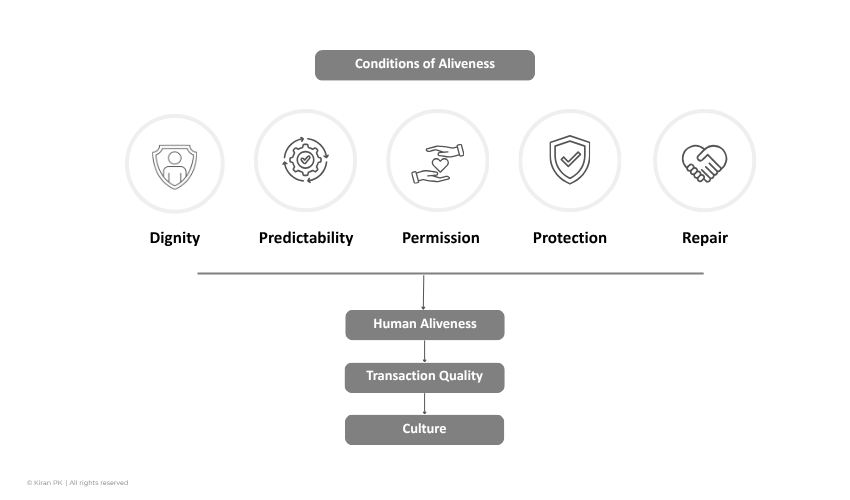
These are the conditions that allow capable adults to work without forcing curiosity, creativity and trust into hiding. They do not create permanent comfort or happiness. They simply make it possible for people to remain open while doing difficult work.
Dignity
The first condition is dignity.
People should be able to have their work challenged without feeling that their entire identity has been placed on trial. Their assumptions can be questioned, their decisions overturned and their performance held to a high standard. None of this requires the person to be diminished in the process.
This distinction is easy to lose under pressure. A conversation about work becomes a judgement about character. Feedback turns sarcastic. Embarrassment is used as a shortcut because explanation requires more patience.
The work may improve in that moment, but something else changes. The next time that person notices a risk, they may hesitate before raising it. The next time they have an unfinished idea, they may decide to keep it to themselves. The next time they need help, they may wait until the problem has become too large to hide.
Dignity is sometimes mistaken for softness. It is actually what allows people to examine their mistakes honestly. When they are not busy defending their worth, they have more capacity to understand what went wrong and do better next time.
Predictability
The second condition is predictability.
Most work contains ambiguity, and no leader can promise certainty. Priorities change, customers behave unexpectedly, markets move and decisions are occasionally made with incomplete information. Predictability is not the promise that nothing will change. It is the confidence that change will be handled in a reasonably dependable way.
People need to understand what is expected of them, how decisions are made and what happens when something goes wrong. They should not have to study their leader’s mood before deciding whether it is safe to speak.
A leader who is generous when results are good and hostile when pressure rises creates an unstable environment. So does a leader who welcomes dissent from senior people but punishes it from junior ones, or who changes the standards depending on who is in the room.
When the environment becomes emotionally unpredictable, people become hypervigilant. They begin paying closer attention to tone, status and politics than to the work itself. A large part of their intelligence is redirected towards self-protection.
Predictability gives that intelligence back to the problem.
Permission
The third condition is permission.
People need room to ask, challenge, explore and produce work before everything is fully formed. Most ideas begin incomplete, and most learning begins with some degree of confusion. Innovation often starts with a question that sounds obvious once someone has answered it.
Many organisations say they value curiosity while rewarding only polished thought. People are encouraged to experiment, but a failed experiment is remembered longer than the insight it created. They are told that questions are welcome, yet uncertainty is quietly treated as weakness.
Over time, people learn to share only what feels safe. The leader may then conclude that the team lacks creativity, when what the team actually lacks is permission.
Permission is created through small responses. Someone asks whether they can show something unfinished and the answer is yes. Someone says they may be wrong and is invited to continue. Someone questions a long-standing assumption and is met with interest rather than irritation.
These moments tell the curious part of the person that it is allowed to enter the room. They also make clarity possible, because people no longer have to perform certainty in order to appear capable.
Protection
The fourth condition is protection.
Values become meaningful when a leader is willing to defend them at some personal cost. It is easy to speak about respect when everyone is behaving respectfully. It is harder when the disrespect comes from someone powerful, a deadline is under threat or the quickest route forward is to let one team absorb the consequences of another team’s failure.
Protection appears when the leader draws a line.
It may involve stopping a public attack, challenging the misuse of authority or refusing to make unreasonable demands appear normal. It can mean absorbing pressure long enough for the team to solve the right problem instead of reacting blindly to the loudest one. It also means ensuring that the most dependable people are not continually asked to carry every emergency simply because they have proved that they will.
Protection does not mean hiding people from reality. Deadlines sometimes cannot move. Performance can genuinely be poor. Difficult decisions still need to be made.
The difference lies in whether reality is faced while preserving the humanity of the people involved. A safe culture is not created through kindness alone. There are moments when a leader has to demonstrate courage on behalf of the environment they claim to value.
Repair
The fifth condition is repair.
Every environment will eventually fail its people. Leaders will make poor decisions, teams will experience conflict and pressure will sometimes lead to behaviour that everyone later regrets.
A healthy culture is not one in which harm never occurs. It is one in which harm is acknowledged and repaired.
Repair often begins with a simple and direct conversation. A leader may admit that they handled something badly, involved someone too late, allowed the pressure to become disrespectful or failed to keep a promise. These statements do not weaken leadership. They make it credible.
Without repair, people learn that values apply only while they are convenient. They may continue doing the work, but they adjust their trust. They share less, become more cautious and commit a smaller part of themselves to the organisation.
Repair shows that a damaged relationship does not have to remain damaged. It demonstrates that the adult in the organisation can take responsibility when things go wrong.
That is how safety becomes believable over time.
Safety is not the absence of discomfort
The Conditions of Aliveness should not be confused with the promise of a permanently comfortable workplace.
Growth is often uncomfortable. Honest feedback can hurt. Change creates uncertainty. Accountability can be difficult, particularly when the work matters and the standard is high.
A person may feel anxious while presenting an idea, disappointed when a decision goes against them or frustrated when the quality of their work is challenged. The presence of discomfort does not automatically mean the environment is unsafe.
The more useful question is what happens to the person inside that discomfort.
Can they retain dignity? Do they understand what is happening? Are they allowed to ask questions? Are the standards reasonably consistent? Will someone intervene if power is abused? Can trust be repaired when the organisation gets it wrong?
A healthy environment does not promise that people will never struggle. It ensures that they do not have to struggle alone, in confusion, while also protecting themselves from the people around them.
This distinction matters because some leaders avoid hard conversations in the name of safety. That does not make people feel safer. It usually creates more uncertainty.
When poor performance is ignored, resentment grows. When decisions are delayed, rumours fill the empty space. When every message is softened until it means almost nothing, people are left trying to guess what the leader is really saying.
The inner child does not need endless reassurance. It needs a dependable adult. Teams are not very different.
Curiosity depends on the environment
We often speak about curiosity as though it were a fixed personality trait. Some people are naturally curious, while others are not.
I am less convinced of that than I once was.
Curiosity expands and contracts depending on the environment. A naturally curious person can become silent in a room where questions are punished. A cautious person can become deeply exploratory once they realise they will not be humiliated for being wrong.
When people feel unsafe, they do not tell you everything they see. They tell you what they believe they can survive saying.
They soften bad news, conceal uncertainty and avoid difficult questions. They agree publicly and resist privately. They use polished language to cover unresolved thinking because the truth feels too expensive.
This has a direct effect on clarity.
A leader can demand clearer thinking, better communication and more honesty, but if the environment punishes people for speaking plainly, they will simply become more skilled at disguising the truth.
The Conditions of Aliveness reduce the personal cost of saying that something is unclear, that a plan is not ready, that a decision may be wrong or that help is needed. These are ordinary statements, but in many organisations they require real courage.
Culture determines how expensive that courage becomes.
Play belongs in serious work
The word “play” can make leaders uncomfortable because it sounds frivolous. Organisations have targets to meet, customers to serve and difficult problems to solve. Nobody wants to suggest that serious work should become a permanent team-building exercise.
Play, however, is not the absence of discipline. It is the freedom to explore before the answer is known.
A designer moving ideas around until a new pattern appears is playing. An engineer testing an unusual approach is playing. A product manager questioning a long-held assumption is playing. A leadership team examining several possibilities before defending a preferred answer is also playing.
Play allows people to test reality without immediately being punished by it. It is how new connections are made and how learning often begins.
A person cannot explore freely while protecting a fixed image of themselves. Discovery requires the freedom to be temporarily wrong. When the inner child feels unsafe, that risk becomes difficult. People repeat what has worked, wait for certainty and seek approval before moving.
When the environment feels safer, someone can say, “Let us see what happens,” without feeling that their reputation depends on getting it right immediately.
Many useful ideas begin in that space.
This does not mean organisations should schedule compulsory fun on Friday afternoons. A sufficiently determined company can remove the joy from almost anything. Play appears naturally when people understand the problem, trust the people around them and feel able to share work before it is perfect.
The leader does not have to manufacture play. They simply have to avoid crushing it.
The connection between people
This pattern is not limited to work. It also shapes how people connect with one another.
Adults usually meet through roles. We meet as colleagues, leaders, clients, parents, friends, partners, neighbours or strangers waiting in the same queue. The adult parts of us manage the exchange. They establish context, read signals and decide what is appropriate.
The deeper connection usually begins when something more human becomes visible. It may be a shared joke, an unexpected confession, a ridiculous story or an enthusiasm that both people assumed nobody else would understand.
The adults establish whether the relationship is safe enough to continue. The children decide whether it feels alive.
This is why people can spend years working beside one another without truly connecting, while two people can meet and quickly feel familiar. The difference is not always the amount of information exchanged. It is what became safe enough to reveal.
Adults build the bridge. The children are the ones who cross it.
Unsafe environments can therefore feel lonely even when they are full of people. Everyone is present, but very little of anyone is available.
The indirect value of aliveness
The effects of the Conditions of Aliveness are often indirect, which makes them easy to overlook.
A person begins drawing again. On the surface, that is a personal hobby with no measurable relationship to the organisation. Yet the drawing restores patience, focus and a sense of identity beyond work. That person returns on Monday less depleted, listens more carefully in a difficult conversation and reacts with less defensiveness when challenged.
The sketch did not improve the decision directly. It improved the person making it.
Someone sets a boundary and stops answering non-urgent messages late at night. The immediate result is more rest, but the indirect result may be less resentment. They become more present with their family, less reactive with colleagues and more willing to help when help is genuinely required.
The boundary did not reduce generosity. It removed some of the bitterness that had become attached to it.
Someone else feels safe enough to become a beginner again. They learn an instrument, try a new role, study a new field or enter a room in which they are not already impressive. That private act changes their relationship with failure. They become more patient with others who are learning and less threatened by people whose strengths are different from their own.
Development is often attributed to courses, coaching and experience. Some of it begins when a person no longer feels compelled to protect the illusion that they already know.
The direct benefit of aliveness may be joy. The indirect benefit is the quality of the person that joy returns to the world.
That matters to organisations, families, friendships, creativity and learning. It influences how people listen, disagree, decide and recover.
The atoms of culture
Culture is usually described through large words such as trust, respect, accountability, courage, excellence and innovation. These words are useful, but people do not experience culture as a set of words.
They experience it through moments.
They experience it when they admit a mistake, challenge a decision or share an unfinished idea. They experience it when they say they are overwhelmed or when someone more powerful behaves badly. They experience it when the leader must choose between protecting the values they speak about and taking the easier route.
These moments are the atoms of culture.
Every response teaches people something. It tells them whether honesty is safe, whether dignity survives failure, whether curiosity is welcome and whether the organisation’s values remain intact when pressure rises.
Over time, people adjust to what they learn. They offer more of themselves or less. They take thoughtful risks or wait for instructions. They speak early or hide the problem until it can no longer be ignored. They become alive within the organisation or learn how to remain merely functional.
Culture is not created during the annual offsite. It is created through thousands of small interactions in which someone decides what is safe enough to reveal.
The Conditions of Aliveness sit beneath those interactions. Dignity, predictability, permission, protection and repair create the ground on which trust and curiosity can grow. They provide the stability that allows capable adults to remain open, even when the work is serious and the pressure is real.
Perhaps this is what I have always meant when I have spoken about creating an environment where people can grow and thrive. The phrase was never only about development plans, learning opportunities or career progression. It was about creating a place where people could become more capable without becoming less human.
Final thoughts
Occasionally, we meet people who seem unusually alive without being unusually loud. They are not permanently excited, nor do they perform happiness or deny difficulty. They still experience disappointment, uncertainty, grief and ordinary bad days.
Something within them simply remains available.
They can still laugh, become interested and be surprised. They can enter a moment without immediately trying to control how it ends. Their adult has not built a perfect life, but it has built a trustworthy relationship with the child living inside it.
Leaders carry a similar responsibility at the level of the environment.
They cannot create perfect organisations, remove every source of conflict or heal every wound that people carry into the workplace. They can, however, build an environment that does not repeatedly deepen those wounds.
They can create dignity, predictability, permission, protection and repair. They can provide enough structure for adults to do difficult work without requiring the curious and creative parts of them to disappear in order to survive.
That may be what it truly means to create an environment where people can grow and thrive. The adults are able to do the work, and the children still want to participate.
Once culture is viewed from that level, another question begins to appear. Every environment is ultimately experienced through interactions: a request made, an idea received, a mistake handled, a boundary respected or ignored, a disagreement explored or shut down.
Some of these exchanges leave people clearer, stronger and more connected. Others leave them guarded, diminished or quietly exhausted. The difference may tell us something about what actually passes between people when they work, help, challenge, refuse and decide together.
Perhaps the quality of our lives and our organisations is shaped not only by the people we are, but also by the quality of the transactions we have with one another.
There is something there. I suspect I will write about it someday.


Pingback: The Transaction Paradox – Kiran's Blog