What designers must learn beyond producing good work
There was a time when the role of a designer in a product organisation was reasonably straightforward. Product decided what needed to be built, engineering worked out how to build it, and design was called in somewhere along the way to make the whole thing usable, presentable or, in less generous environments, prettier.
Many designers will remember receiving requirements that were already suspiciously close to a finished solution. The workflow had been decided, the technical approach agreed upon, and the delivery date announced. Design was invited in with a warm welcome and approximately forty-eight hours to “work its magic.”
The message, even when nobody said it aloud, was simple: colour between the lines.
Design has spent much of the last two decades trying to move beyond that role. We argued that customer experience could not be added at the end of a delivery process. We pushed to participate in discovery, planning, customer conversations and product strategy. Eventually, the profession adopted one of its most enduring phrases: design deserved a seat at the table.
In many organisations, we got one.
The results, however, have been mixed.
Sometimes design is genuinely involved in shaping the direction of a product. At other times, the designer is technically present but has little influence over the outcome. There are also situations where design is invited into every meeting, which initially feels like progress until the designer discovers that the reward for gaining influence is now spending six hours a day discussing Jira tickets.
The seat itself was never the real objective. The ability to shape decisions was.
That requires more than being good at design.
Over the years, I have watched designers with exceptional portfolios struggle to build influence. I have also watched quieter designers, sometimes without the most polished visual craft, become indispensable to an entire product area. When something important needed to move, people looked for them. They were included early, trusted with ambiguity and given increasingly difficult problems.
The difference was not that craft stopped mattering. Craft matters enormously. But craft alone rarely explains why one person becomes trusted to lead important work while another remains primarily a producer of design outputs.
The difference is usually found in how a person operates: how they understand their environment, build product knowledge, communicate their thinking, work through disagreement, earn trust and take responsibility for their own development.
Looking back, I see five stages through which strong designers tend to move. They are not official career levels, nor do they always occur neatly in sequence. They are simply patterns that appear as a designer grows from someone who produces good work into someone who can help an organisation move forward.
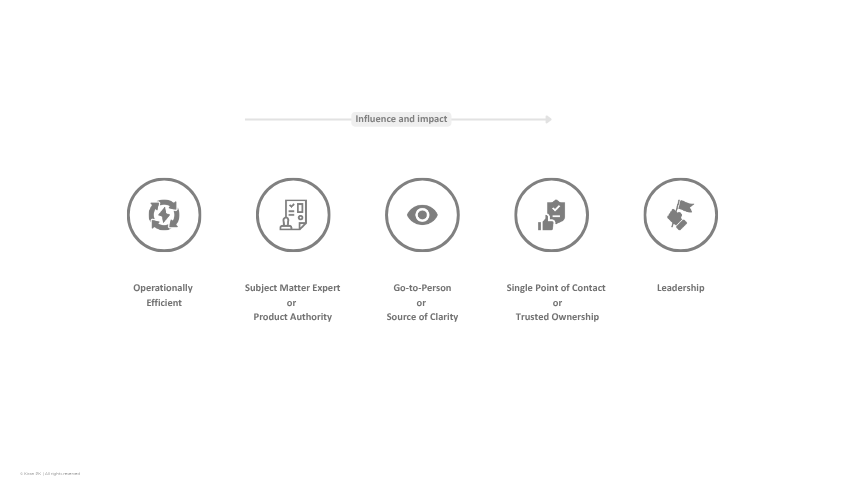
Stage One: Becoming Operationally Effective
The first stage is not glamorous. Nobody puts it in a portfolio, and very few people write celebratory posts about finally understanding the release calendar.
Yet it is one of the clearest differences between designers who constantly feel blocked and those who appear able to move without carrying the entire weight of the organisation on their backs.
Operationally effective designers learn how the place works. They understand who owns which decisions, which stakeholders need to be involved, how the roadmap is shaped, where dependencies sit and how work eventually reaches production. They know enough of the product’s history to avoid proposing something that failed three years ago for reasons everyone else still remembers.
They also develop working familiarity with the disciplines surrounding design. They may not be accessibility specialists, researchers, content designers or design-system experts, but they know enough to recognise when something is missing. More importantly, they know whom to involve and when.
This does not require memorising the organisation chart or knowing every answer. It requires reducing uncertainty about the next move.
One of the greatest sources of wasted time in product development is not simply that people lack information. It is that they do not know what to do when they lack information. They are unsure whether to speak to engineering, product, research, content or another design team. They wait for someone to direct them. A day becomes a week, and the organisation develops another small mystery about why the work is taking so long.
Strong designers become good navigators. When they encounter a gap, they know where to look. When they hit a dependency, they know whom to involve. When ownership is unclear, they do not quietly wait for clarity to descend from the heavens. They begin the conversation required to create it.
This is not administrative competence sitting outside design. It is part of design effectiveness. A brilliant designer who repeatedly loses momentum because they cannot navigate their environment will eventually be seen as less capable than they really are.
The first stage, therefore, is not about moving faster for the sake of speed. It is about removing avoidable friction from your own work and, increasingly, from the work of those around you.
Stage Two: Becoming a Product Authority
Once a designer is no longer spending most of their energy figuring out how the organisation works, they can invest more deeply in understanding the product itself.
This is where the designer starts becoming more than a visitor to the problem space.
They learn how the product behaves, but also why it behaves that way. They understand its major workflows, edge cases, technical limitations and customer expectations. They know which features are heavily used, which exist because a large customer once demanded them, and which appear simple until someone explains the three legacy systems quietly holding everything together.
Every mature product contains history. There are abandoned ideas, partial migrations, compromises, customer commitments, duplicated patterns and features that everyone complains about but nobody can safely remove. Product expertise means understanding enough of that history to make better decisions about the future.
This is not the same as carrying the entire product in your head. In fact, the most credible subject-matter experts are often careful about the limits of their knowledge. They know when they can answer confidently, when they should verify something and who is most likely to know the truth.
That distinction matters. Confidence is not answering every question immediately. Confidence is being clear about what you know, what you suspect and what still needs to be checked.
Designers often underestimate how much trust is created by saying, “I believe this is how it works, but I want to confirm it with the platform team before we make the decision.” That is not weakness. It is judgement.
At this stage, stakeholders begin experiencing the designer differently. The designer is no longer discussing only screens and flows. They can connect design decisions to customer behaviour, technical constraints, roadmap direction and product history. Their recommendations become harder to dismiss because they are grounded in more than preference.
The designer is beginning to understand the product as a system rather than as a collection of interfaces.
Stage Three: Becoming a Source of Clarity
The third stage is harder to identify because it rarely arrives with a title or formal announcement. It develops slowly through repeated interactions.
At some point, people begin seeking a particular designer out. They ask for their perspective before a meeting. They bring them a problem that is not yet fully formed. They include them in conversations that sit slightly outside their formal scope. When disagreement emerges, someone eventually says, “Let’s get their view.”
It is tempting to describe these designers as easy to work with or as natural people-persons. Those phrases are not entirely wrong, but they are incomplete and can be misleading.
Being easy to work with does not mean being endlessly agreeable. It does not mean avoiding conflict, accepting every request or smiling serenely while someone dismantles six weeks of work in a roadmap meeting. Some of the most trusted people in an organisation are perfectly capable of challenging a poor decision.
What makes them valuable is that they make disagreement productive.
They can question an assumption without embarrassing the person who made it. They can explain why a request is problematic without simply throwing the problem back over the wall. They can acknowledge a real constraint while still exploring whether the team has accepted it too quickly. They can say no while helping the group find a better route forward.
People seek them out because conversations with them tend to reduce confusion.
A problem may not be solved in that conversation, but it becomes clearer. The decisions become visible. The missing people are identified. The next step stops being ambiguous.
This is not charisma. It is usefulness.
Many professionals focus on proving that they are right. Trusted professionals focus on helping the group become more capable of moving forward. Sometimes that means providing an answer. Sometimes it means asking the question everyone else has avoided. Sometimes it simply means recognising that three people are arguing about different versions of the same problem.
Reputation begins to compound at this stage. The designer becomes known as reliable, constructive and thoughtful. Not because they make every interaction pleasant, but because they do not allow complexity to turn into theatre.
There is often an unspoken distinction in organisations between people who bring clarity into a room and people who add another weather system. Both may be talented. Only one will consistently be invited into the most difficult work.
Stage Four: Becoming a Trusted Point of Ownership
The fourth stage is where informal credibility begins to become explicit trust.
A leader starts positioning the designer as the person responsible for a particular area, initiative or outcome. The title may not change, and there may be no official announcement, but the language around them does.
“Speak to her. She is leading that work.”
“He can represent design in that conversation.”
“She knows the space and can make the call.”
This is more significant than becoming a single point of contact. A point of contact may simply be the person who attends the meetings or forwards the emails. A trusted point of ownership is someone the organisation believes can exercise judgement.
That trust is rarely built through one dramatic act. It usually comes from a collection of surprisingly ordinary behaviours. You do what you say you will do. You communicate when something changes. You raise risk before it becomes a crisis. You do not hide bad news until the night before a review. You admit when you have made a mistake. You close loops, make decisions at the right level and escalate the ones that exceed your authority.
In other words, your say-do ratio becomes dependable.
Leaders are often accused of repeatedly giving opportunities to the same people. Sometimes that criticism is justified. Bias and favouritism exist. Access is not distributed evenly, and organisations are not pure meritocracies, regardless of what the values poster near reception claims.
But there is another pattern worth acknowledging. Leaders often return to people who have demonstrated that they can be trusted with ambiguity without requiring constant rescue. When the stakes rise, predictability becomes valuable.
This does not mean never needing help. Trusted people ask for help. The difference is that they do so with context, options and a clear explanation of what they need. They do not transfer the entire burden upward and call it escalation.
It is also at this stage that the relationship between a designer and their leader begins to matter in a different way. A good leader may provide visibility, context, air cover and opportunities that stretch the designer beyond their current role. They may advocate for that person in rooms they have not yet entered or attach their own credibility to giving them a larger responsibility.
That support should not create a debt of loyalty or gratitude. But it should not be treated as automatic either.
The healthiest relationship is reciprocal. The leader extends trust and creates opportunity. The designer responds with preparation, ownership, honest communication and a serious commitment to their own development. A leader can open the door, but cannot walk through it on someone else’s behalf.
At this stage, the organisation is no longer trusting only the quality of the designer’s output. It is trusting the person to represent the work, the customer and the design perspective when their leader is not present.
That is a much larger responsibility than producing a good screen.
Stage Five: Becoming a Leader
By the fifth stage, the designer may or may not hold an official leadership title.
They may manage a team. They may be a principal designer, a lead or an individual contributor whose influence stretches far beyond their formal role. The title matters less than the pattern.
They have become someone who can create movement through other people.
This is where leadership is often misunderstood. Leadership does not mean taking over every problem or becoming the person who quietly does the jobs of product, engineering, research, content and three absent executives. That is not leadership. That is an unsustainable staffing model.
Leadership is the ability to bring the right people together, establish shared understanding, clarify responsibility and keep the group moving toward an outcome.
The greatest ability a team member can develop is not simply the willingness to say, “That is not my job.” There are, of course, legitimate boundaries. Healthy teams require clear roles, and people should not be expected to absorb endless work because someone else has failed to do theirs.
But stopping at the boundary rarely solves the problem.
The stronger response is to recognise what needs to happen and help create the conditions in which the right person can do it. A strong designer does not replace the researcher. They make the research need clear and involve the researcher. They do not write the technical architecture. They bring engineering into the decision early enough for the architecture to shape the experience. They do not silently take over product management. They work with product to clarify the outcome, the priorities and the trade-offs.
They are not doing everyone’s job. They are helping everyone do their job in service of the same goal.
That may sound idealistic because, in some organisations, it is. Teams do not always cooperate. Incentives conflict. People protect territory. Some stakeholders arrive with answers rather than questions, and some meetings are held primarily because nobody wants to make a decision.
This is precisely why leadership matters. Leadership is not most visible when the environment is already aligned. It is tested when alignment does not exist.
By this stage, the designer has combined operational fluency, product depth, credibility and trust. Their craft has not disappeared. It has become more powerful because it is now connected to the organisation’s ability to act.
The Model Is Not a Ladder
These stages do not unfold neatly. A designer may know a product deeply and still struggle with stakeholders. Another may be widely trusted but have gaps in their craft. Someone who becomes highly influential in one product area may feel like a beginner after moving to another.
Growth is also not entirely an individual achievement. Organisations determine who receives context, access, sponsorship and meaningful opportunities. Poor leadership, unclear expectations and exclusion from decision-making can restrict even a capable designer. Personal ownership matters, but it does not excuse an organisation that repeatedly asks people to grow while denying them the conditions in which growth can happen.
Craft also deserves more credit than the profession sometimes gives it. It is not simply visual polish or mastery of a design tool. It includes problem framing, interaction thinking, systems thinking, storytelling, prototyping and judgement.
The argument is not that craft matters less. It is that craft alone cannot carry work through disagreement, complexity and organisational inertia.
A beautifully designed solution that cannot survive contact with the organisation is not yet a successful solution.
Beyond the Seat at the Table
Product design fought for a seat at the table because designers wanted to help shape decisions, not merely make those decisions presentable after the fact.
Earning that seat required craft. Becoming useful once there requires more.
The designers who grow understand how work moves, know their product deeply, reduce uncertainty, earn trust and help people align around a shared outcome. They do not need to have every answer or perform everyone else’s job. They need to know how to bring the right people together and help the work move forward.
Craft gets a designer into the conversation. What they do with the conversation determines the influence they eventually earn.
Now that design is in the room, the next stage of our growth depends on whether we can help the room make better decisions.